


Bricka
Giochi > Giochi di tavoliere astratti > A-B > Bob-Byt > Bricka


Introduction
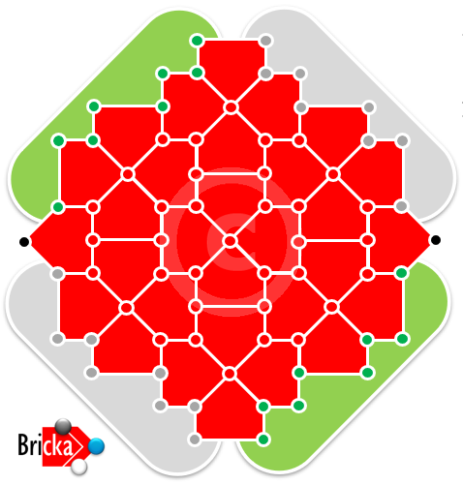
The game was devised by Marino Carpignano in 2023 and published in the same author’s book Il Manuale dei Giochi di Tavoliere (October 2023). It is played on a special board consisting of thirty pentagonal cells and sixty-nine intersections, on which the pieces are gradually placed. When a player occupies a majority of the intersections of a cell, the piece just played becomes neutral. The first player to connect two opposite sides of the board with an unbroken chain of their own and/or neutral pieces wins.
Figura 1
Figura 2
Figura 3
How to Play
The game consists of:
- a board comprising thirty cells (see Figure 1); note that some cells have five intersections, while others have six
- a number of white, black and blue pieces.
The game is played by two players. The initial position is shown in Figure 1 (empty board). Players take turns. Each player makes one move per turn. White moves first.
On their turn, a player must place one of their pieces on any free and unblocked intersection of the board.
Cells that share the intersection on which a piece was placed during the immediately preceding turn are called “blocked”. The cells that share the intersection on which a piece was placed during the current turn are called “active cells”. Intersections belonging to blocked cells are also blocked and therefore inaccessible to the player whose turn it is.
In the example shown in Figure 2, White has played at f6; on the following turn, Black cannot play at e8, f8, e7, g7, e6, h6, d5, f5, h5, e4 or f4: these are the intersections belonging to the cells (shown in grey) that share the intersection f6.
After placing a piece, if the player has occupied a majority of the intersections not occupied by neutral pieces in at least one of the active cells, the piece just played becomes neutral (blue).
For example, if a cell with five intersections has one intersection occupied by a neutral piece, four intersections remain (whether empty or partly occupied by white or black pieces), and therefore the majority is three. If a cell with five intersections has two intersections occupied by neutral pieces, three intersections remain, and the majority is therefore two.
Figure 3 shows the beginning of an example game. On move 11, White plays at i8 and thereby occupies a majority of the intersections of the cell h10-h9-h8-i10-j9-i8. The piece just played is replaced by a neutral piece.
The first player to connect two opposite sides of the board with an uninterrupted chain of their own and/or neutral pieces at the end of their turn wins. The opposite sides are the light sides (from h13 to l8 and from b6 to f1), the green sides (from b8 to f13 and from h1 to l6), and the dark sides (a7 and m7). If both players have a valid connection, the active player (the player who made the move) wins.
A player with no legal moves must pass. If both players are forced to pass, or if there are no free intersections left, without either player having achieved the objective, the player with the greater number of pieces of their own color on the board wins. The game may end in a draw.

Ultimo aggiornamento: 22/10/2026